Sunday, 24 November 2013

Goodbye McMullen Hello Eady

There's been a shuffling around of the Old Square seats at the Employment Appeal Tribunal as Jeremy McMullen QC late of those Chambers retires and Jennifer Eady QC of Old Square and oft to be found as Jeremy's junior takes his place as a Circuit Judge of the EAT.  Jennifer was last in the spot light unsuccessfully representing John McCririck at London Central.  She is a ACAS Council member and was once standing council to the NUJ and NUM.  McMullen spent 11 year working for the GMB.  Both have been heavily involved in the Industrial Law Society (both Vice Presidents) and both were part time Employment Judges.  Eady in other words, is a good replacement for McMullen.  I only hope I get on better with her than I did with him.


Sunday, 17 November 2013

This will get the Europsceptics going....

Some Swedish chap did not like being tried twice for some domestic VAT offence.  So off he popped to the ECJ in Luxembourg who ruled that he could have the benefit of Protocol 7 of the European Convention of Human Rights because it is mirrored in article 50 of Charter of Fundamental Rights of the European Union which states

‘No one shall be liable to be tried or punished again in criminal proceedings for an offence for which he or she has already been finally acquitted or convicted within the Union in accordance with the law.’

How can the ECJ effectively alter a democratically passed piece of legislation which allowed you to be tried twice in Sweden for a VAT offence? Quite a few Govts intervened to make this point to the Court (although not the UK):

The Swedish, Czech and Danish Governments, Ireland, the Netherlands Government and the European Commission dispute the admissibility of the questions referred for a preliminary ruling. In their submission, the Court would have jurisdiction to answer them only if the tax penalties imposed on Mr Ã…kerberg Fransson and the criminal proceedings brought against him that are the subject-matter of the main proceedings arose from implementation of European Union law. However, that is not so in the case of either the national legislation on whose basis the tax penalties were ordered to be paid or the national legislation upon which the criminal proceedings are founded. In accordance with Article 51(1) of the Charter, those penalties and proceedings therefore do not come under the ne bis in idem principle secured by Article 50 of the Charter.

The Court held that the underlying criminal law did not have to be based upon EU Law - it just had to be in a field in which EU Law operates:

The Court’s settled case-law indeed states, in essence, that the fundamental rights guaranteed in the legal order of the European Union are applicable in all situations governed by European Union law, but not outside such situations. In this respect the Court has already observed that it has no power to examine the compatibility with the Charter of national legislation lying outside the scope of European Union law. On the other hand, if such legislation falls within the scope of European Union law, the Court, when requested to give a preliminary ruling, must provide all the guidance as to interpretation needed in order for the national court to determine whether that legislation is compatible with the fundamental rights the observance of which the Court ensures

So, in other words, if you can squeeze your case into are area of law in which the EU has an interest, then you can rely on lots of rights under the EU Charter which your national legislature has not enacted.  For example Protocol 7, in use here, has not been 'brought home' under Human Rights Act 1998 which would be just as well as you can in certain circumstances be tried twice under our domestic law (Part 0, CJA 2003) -  although if the prosecution could possibly come within some piece of EU Law, then think again prosecutors....

Mostyn J has just realised what is going on in a recent judgment:


& the usual suspects are warming up:

Bill Cash, Tory chairman of Parliament’s EU scrutiny committee, said: ‘We are in a position where the ECJ has effectively struck down an act of Parliament. If they can do it to this, they can do it to anything.’

Watch this space...........

Monday, 11 November 2013

Surprise Welsh Appointment

Surprise appointment in Cardiff as 4NS announce that Leigh-Ann Mulcahy QC has been appointed First Counsel to the Welsh Government, a position previously held by (Clive) Lewis J.  Have to say I had rather assumed you had to be linked to Wales in some way -  Rhodhri Williams QC had been tipped by me as the only really serious public law silk in Wales - but there you go - there is nothing that requires them to only look in Wales.

Leigh-Ann looks like she has had some pre-QC A Panel experience in E&W and can probably brush up on some Welsh should it arise.

The 4NS tweet:

Congratulations to 's Leigh-Ann Mulcahy QC on her appointment as First Counsel to the Welsh Government:

Sunday, 20 October 2013

Keep private law out of public war.

Lots in the press of late (drummed up by this interesting paper) about how judges should not judge acts of war by the standards of the common law tort of negligence or the requirements of article 2 ECHR.  I agree that personal injuries sustained in war should be the subject of no-fault compensation (as they are via AFCS) and should be non-justiciable such that the commander on the ground should not worry about the MOD being sued depending on his tactical and strategic choices and commands.  The Supreme Court (by a thin majority) have refused to strike out claims for personal injuries suffered in battle conditions because they wanted a trial judge to make findings of fact before the courts come to a final view.  In particular these findings are to assist in the teasing out of the question of whether a procurement decision made many moons before the war (i.e. to buy some snatch land rovers) can be held negligent and/or a breach of article 2 such as to justify an award of damages for an injury suffered because it is alleged that insufficient armoured protection was offered by the said land rovers in battle.

The State's decision about what tanks to buy and how armoured they should be is no more justiciable than a company commander's decision about who to send into battle with what weapons in the heat of the action.  The Courts have no business asking independent experts to offer them opinion evidence in order to decide whether HMG should have bought and deployed the big tanks rather than the small tanks.  These are questions absolutely vested in the Executive supervised by the Legislature.  These are not questions of law, but of competing priorities for the public purse and fine judgments about what military equipment works best in different environments.

Who knew before Bushs Snr and Jnr had their bright ideas that our Cold War trained and armed military would spend 20 years in the Iraqi and Afghan deserts?  Judicial hindsight can often be a dangerous thing, but it will utterly overreach itself if it starts to judge procurement decisions made in the late 1980s against the actual events of the next 20-30 years.

The Rule of Law requires Judges to oversee the Executive.  Judicial Review is a marvellous thing which is reduced or undermined at our peril.  But Judges deciding whether to give the State's foot soldiers compensation based on their master's decisions many moons ago is a step too far.  That is a matter for political oversight in the select committee and for the no-fault compensation scheme which exists for members of the armed forces (which should dish out common law damages in return for immunity for the Crown) and not for the court room.

The Lawyers have had a good war so far,  the counter-terrorism measures, the immigration strictures, rendition, secret prisons and the never ending public inquiries have been a boon for our human rights legal sector.  But let us not get carried away.  Their are limits to the judicial power and it is time to start applying them.  Best the Judges get in first to limit their own role using common law immunity or else they may find Parliament intervening with a statute. Our constitution requires harmony between its component parts and this is just the sort of issue over which a war of words could break out.

Judges take heed, the politicians (and the Chiefs of Staff) are speaking.


Wednesday, 2 October 2013

New Justice of Supreme Court, from Scotland.

Lord Hodge, 'stolen from Scotland' for the Supreme Court to replace Lord Hope VP (replaced as VP by Lady Hale).  Might be one of the last Scottish appointments before secession?  Hope not (on both fronts).


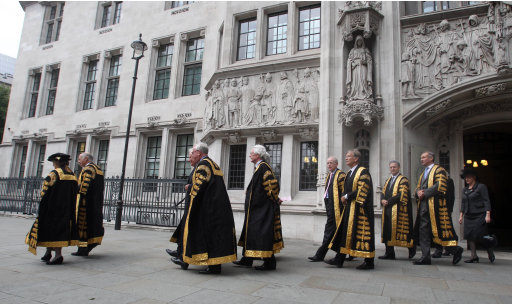
Then off they processed for the Abbey Service and LC's breakfast, P and VP in the lead:


Sunday, 29 September 2013

Shuffling around at the top in time for the start of another Legal Year


Tuesday marks the start of another Legal Year and this year the start of the term of office of the new LCJ -

Sir Roger John Laugharne Thomas - raised to the peerage for the occasion it has been announced (in
line with previous practice!)  

His successor as P of the QBD is to be a frontrunner for the LCJ'ship itself and a man who needs no introduction to the masses - Leveson LJ - a well earned promotion!

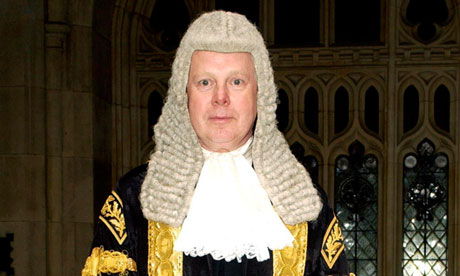
Here he is in his other new role as Chancellor of Liverpool John Moores University:


Bit of a move around in the provinces as well following the elevation of the Recorder of Greenwich to head up the Old Bailey, and the criminal Resident Judge and DCJ in Manchester's elevations to the High Court - they have all now been replaced:

25-09-2013 01:09 AM BST

The Queen has appointed His Honour Judge Christopher Anthony Kinch QC as a Senior Circuit Judge, Resident Judge for Woolwich on the advice of the Lord Chancellor, the Right Honourable Chris Grayling MP.
24-09-2013 01:09 AM BST

The Lord Chancellor, the Right Honourable Chris Grayling MP, has appointed His Honour Judge David Andrew Stockdale QC as Senior Circuit Judge, Resident Judge for Manchester.
24-09-2013 01:09 AM BST

The Lord Chancellor, the Right Honourable Chris Grayling MP, has appointed His Honour Judge Allan Peter Gore QC to be a Senior Circuit Judge, Designated Civil Judge for Manchester.

Thursday, 26 September 2013

What is Grayling talking about?

Apparently the Lord High Chancellor of Great Britain, the second most important Great Office of State,  Lord Keeper of the Great Seal  and Keeper of the Queen's Conscience has said he wants

 "to see our Supreme Court being supreme again"

If he means the Supreme Court of the United Kingdom - it has never been supreme but has always been subject to the jurisdiction of the European Court of Justice and must take into account the judgments of the European Court of Human Rights. If he means the Supreme Court of Judicature which was renamed the Senior Courts when the new Supreme Court came into being, well that was always subject to an appeal the House of Lords, which itself, since 1972, has been bound by the ECJ and since 1998, taking notice of the ECtHR. In short, he is talking nonsense. Again. 

Remind me.  Why was it good idea to appoint a lawyer to this great office of state, even when it ceased to be at the apex of the judiciary?