Sunday, 20 October 2013

Keep private law out of public war.

Lots in the press of late (drummed up by this interesting paper) about how judges should not judge acts of war by the standards of the common law tort of negligence or the requirements of article 2 ECHR.  I agree that personal injuries sustained in war should be the subject of no-fault compensation (as they are via AFCS) and should be non-justiciable such that the commander on the ground should not worry about the MOD being sued depending on his tactical and strategic choices and commands.  The Supreme Court (by a thin majority) have refused to strike out claims for personal injuries suffered in battle conditions because they wanted a trial judge to make findings of fact before the courts come to a final view.  In particular these findings are to assist in the teasing out of the question of whether a procurement decision made many moons before the war (i.e. to buy some snatch land rovers) can be held negligent and/or a breach of article 2 such as to justify an award of damages for an injury suffered because it is alleged that insufficient armoured protection was offered by the said land rovers in battle.

The State's decision about what tanks to buy and how armoured they should be is no more justiciable than a company commander's decision about who to send into battle with what weapons in the heat of the action.  The Courts have no business asking independent experts to offer them opinion evidence in order to decide whether HMG should have bought and deployed the big tanks rather than the small tanks.  These are questions absolutely vested in the Executive supervised by the Legislature.  These are not questions of law, but of competing priorities for the public purse and fine judgments about what military equipment works best in different environments.

Who knew before Bushs Snr and Jnr had their bright ideas that our Cold War trained and armed military would spend 20 years in the Iraqi and Afghan deserts?  Judicial hindsight can often be a dangerous thing, but it will utterly overreach itself if it starts to judge procurement decisions made in the late 1980s against the actual events of the next 20-30 years.

The Rule of Law requires Judges to oversee the Executive.  Judicial Review is a marvellous thing which is reduced or undermined at our peril.  But Judges deciding whether to give the State's foot soldiers compensation based on their master's decisions many moons ago is a step too far.  That is a matter for political oversight in the select committee and for the no-fault compensation scheme which exists for members of the armed forces (which should dish out common law damages in return for immunity for the Crown) and not for the court room.

The Lawyers have had a good war so far,  the counter-terrorism measures, the immigration strictures, rendition, secret prisons and the never ending public inquiries have been a boon for our human rights legal sector.  But let us not get carried away.  Their are limits to the judicial power and it is time to start applying them.  Best the Judges get in first to limit their own role using common law immunity or else they may find Parliament intervening with a statute. Our constitution requires harmony between its component parts and this is just the sort of issue over which a war of words could break out.

Judges take heed, the politicians (and the Chiefs of Staff) are speaking.


Wednesday, 2 October 2013

New Justice of Supreme Court, from Scotland.

Lord Hodge, 'stolen from Scotland' for the Supreme Court to replace Lord Hope VP (replaced as VP by Lady Hale).  Might be one of the last Scottish appointments before secession?  Hope not (on both fronts).


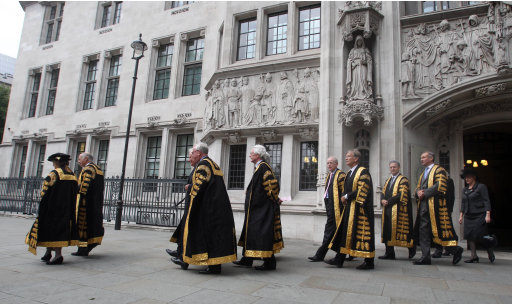
Then off they processed for the Abbey Service and LC's breakfast, P and VP in the lead:


Sunday, 29 September 2013

Shuffling around at the top in time for the start of another Legal Year


Tuesday marks the start of another Legal Year and this year the start of the term of office of the new LCJ -

Sir Roger John Laugharne Thomas - raised to the peerage for the occasion it has been announced (in
line with previous practice!)  

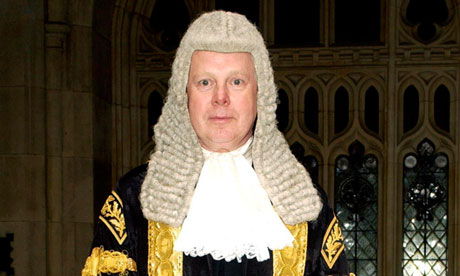
His successor as P of the QBD is to be a frontrunner for the LCJ'ship itself and a man who needs no introduction to the masses - Leveson LJ - a well earned promotion!

Here he is in his other new role as Chancellor of Liverpool John Moores University:


Bit of a move around in the provinces as well following the elevation of the Recorder of Greenwich to head up the Old Bailey, and the criminal Resident Judge and DCJ in Manchester's elevations to the High Court - they have all now been replaced:

25-09-2013 01:09 AM BST

The Queen has appointed His Honour Judge Christopher Anthony Kinch QC as a Senior Circuit Judge, Resident Judge for Woolwich on the advice of the Lord Chancellor, the Right Honourable Chris Grayling MP.
24-09-2013 01:09 AM BST

The Lord Chancellor, the Right Honourable Chris Grayling MP, has appointed His Honour Judge David Andrew Stockdale QC as Senior Circuit Judge, Resident Judge for Manchester.
24-09-2013 01:09 AM BST

The Lord Chancellor, the Right Honourable Chris Grayling MP, has appointed His Honour Judge Allan Peter Gore QC to be a Senior Circuit Judge, Designated Civil Judge for Manchester.

Thursday, 26 September 2013

What is Grayling talking about?

Apparently the Lord High Chancellor of Great Britain, the second most important Great Office of State,  Lord Keeper of the Great Seal  and Keeper of the Queen's Conscience has said he wants

 "to see our Supreme Court being supreme again"

If he means the Supreme Court of the United Kingdom - it has never been supreme but has always been subject to the jurisdiction of the European Court of Justice and must take into account the judgments of the European Court of Human Rights. If he means the Supreme Court of Judicature which was renamed the Senior Courts when the new Supreme Court came into being, well that was always subject to an appeal the House of Lords, which itself, since 1972, has been bound by the ECJ and since 1998, taking notice of the ECtHR. In short, he is talking nonsense. Again. 

Remind me.  Why was it good idea to appoint a lawyer to this great office of state, even when it ceased to be at the apex of the judiciary?

Sunday, 15 September 2013

The - No legal aid until you get permission to claim Judicial Review - Volte Face

Sometimes I am drawn into the odd judicial review - although it is not my central field of practice.  I have noticed that the key phase of such a claim is the application for permission - once a Claimant is through that tough judicial filter then the prospects of the Defendant giving up and compromising is high.  Many claims end at that stage saving money (both the Court's and the public law defendant's resources as well as any public funding being used by the Claimant).

I understand that the MoJ wanted to reduce the number of JR claims by only providing public funding once the claim has permission to proceed.  That's about as bonkers as it gets because that's no funding at all - how does the impecunious claimant get permission without funding and without permission how does he make a claim??  It would actually be better only to provide funding up to the grant of permission - because usually if permission is granted the other side will fold or the claimants' lawyers might take a CFA risk given that the Court thinks that they have prospects of success.  Indeed a CFA post permission with a protective costs order would be a good way of funding JRs post-permission.

But removing funding pre-permission really just means removing JR from poor people, and given that poor people tend to interact with the state more than rich people, especially on key life sustaining topics like benefits (i.e. eating and living), housing (i.e. living) and immigration (not being sent to bad places) then it amounts to a Government decision to withdraw JR from those who need it most.

Which is what would make such a move quite important, if not of constitutional importance.

Sir Stephen Sedley got upset about it in the London Review of Books here  as did Treasury Counsel and lots of silks....and so on 5th Sept HMG dropped it....like a stone:

“For payment for permission work in judicial review cases, in the light of responses to this proposal, we intend to consult further on an alternative option which will achieve our desired aim of preventing legal aid being used to fund weak cases which have little effect other than to cause delay and incur unnecessary cost.”

Didn't see that coming.

Hurrah.


Friday, 6 September 2013

Upholding the Rule of Law

The former Lord Chief Justice at the Annual Judges; Mansion House Speech in July before his retirement with some excellent words of warning for HMG:
So we must remain vigilant against the slightest encroachment on judicial independence, not because judicial independence represents some traditional flummery, some bauble, some meaningless superficiality, but because without an independent judiciary the rule of law would collapse.

A more mundane story of protecting the dignity of the judicial process:

Paul, of South Road, Luton was sitting in the public gallery of Luton Crown Court watching a friend’s sentencing for the robbery of an off-duty police officer, when he received a message on his BlackBerry phone from a girl asking where he was.
He thought he would take a snap of the courtroom to send to her, but sitting in front of him were the victim and other police officers involved in the case, who spotted what he had done.
The phone was seized and to his amazement the teen found himself arrested and taken down to the cells.
After his arrest, barrister John Livingston was appointed to represent the teenager.
An hour later he was brought back into the court to hear Mr Livingston say: “He told me he was being ‘a dick’, which I take to mean a stupid idiot.
“It was not a photograph of anyone in particular and he did not notice any signs forbidding this behaviour. This has been a very big shock for him.”
But Judge Mensah told Thompson: “There are notices all around the court building about not taking photographs in court. This is a serious offence and the message must go out that people cannot take
photos.”
As she jailed him for two months he said: “That’s stupid man.”

Friday, 9 August 2013

ON HOLIDAY...BACK SOON

Celebrating a first successful flutter on a nice little CFA- although I don't think I'll try that again...never been so stressed about the result of a case...all seemed very seedy...back to earning regardless of result after a well earned rest...................